
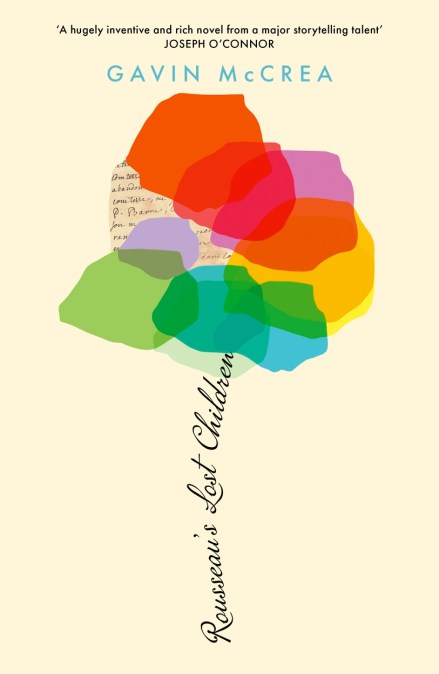
Paris, 1777. The philosopher Jean-Jacques Rousseau receives a mysterious letter from a foreign visitor, Gavin Mulvany, asking whether the great man will take walks with him. Against his better judgement, Rousseau agrees. Might this stranger, who claims to be from the twenty-first century, be the true friend that Rousseau has been searching for his whole life?
Paris, 2022. Gavin, a middle-aged academic, leaves his husband behind in Ireland to finish a long-delayed biography of Rousseau. While in Paris, he avoids work on his book by instead taking walks with Rousseau himself. As they wander the streets, Gavin and Rousseau open up about certain past actions that have come to define them. Was Rousseau justified in abandoning his children? Should Gavin be forgiven for the terrible crime he committed to protect a man he once loved? Can talking and walking together lead both Gavin and Rousseau to finally be honest with themselves and their loved ones, and to a better understanding of what love, family, and society really mean?
Rousseau’s Lost Children is a thrilling epistolary novel cast across centuries, a bold and illuminating investigation into the boundaries of personal liberty and matters of morality, desire and loyalty.
Paris, 2022. Gavin, a middle-aged academic, leaves his husband behind in Ireland to finish a long-delayed biography of Rousseau. While in Paris, he avoids work on his book by instead taking walks with Rousseau himself. As they wander the streets, Gavin and Rousseau open up about certain past actions that have come to define them. Was Rousseau justified in abandoning his children? Should Gavin be forgiven for the terrible crime he committed to protect a man he once loved? Can talking and walking together lead both Gavin and Rousseau to finally be honest with themselves and their loved ones, and to a better understanding of what love, family, and society really mean?
Rousseau’s Lost Children is a thrilling epistolary novel cast across centuries, a bold and illuminating investigation into the boundaries of personal liberty and matters of morality, desire and loyalty.
Newsletter Signup
By clicking ‘Sign Up,’ I acknowledge that I have read and agree to Hachette Book Group’s Privacy Policy and Terms of Use
Reviews
'A heart-stopping excavation of the self . . . Cells will heighten the capacity for empathy in all who read it. Not least of all, empathy for the self'
'Beautifully written, fearless, vulnerable, self-aware . . . Cells will comfortably sit alongside other great Irish memoirs by Nuala O'Faolain and John McGahern'
'Raw and deeply affecting'
Cells is a raw, throbbing thing; the literary equivalent of an open wound, but one that's been cauterised by a highly skilled surgeon . . . the story of the making of an acutely talented writer . . . One of the very best, most authentic, beautiful, and brutal depictions of a deep and abiding, albeit imperfect love between a son and his mother
'Flayingly authentic and sensationally compelling . . . One of the best books of the year'
Praise for Cells
Smart, formally playful, and psychologically astute, Rousseau's Lost Children is a novel of ideas with moral insight and real emotional power
A masterful work of imagination, intellect and empathy that further cements McCrea as a singular voice in literature. This is a formally inventive fusion of historical and contemporary fiction that succeeds in illuminating both the past and the present with profound vision and grace
A hugely inventive and rich novel from a major storytelling talent
Rosseau's Lost Children is such an original, absorbing, illuminating novel; an exploration of life's big themes - love, loyalty and truth - from a writer of tremendous skill and brilliance
A novel quite unlike anything else. McCrea is an astonishingly talented writer, the breadth of his ability matched only by the magnitude of his ambition. His formal risks pay off in spades. This is an astounding narrative achievement. I loved every page
Rousseau's Lost Children pulls off the admirable feat of being as fun to read as it is creatively daring and rich with ideas. The glare of Enlightenment philosophy and the moral murk of contemporary sexual politics collide in the strange prism of Gavin McCrea's imagination